
Reconditioning Costs Against Resale Value
Every used vehicle that arrives on our lot represents a unique opportunity. The key to unlocking its full potential lies in the delicate art of balancing reconditioning costs against its final resale value. This is not simply about fixing what is broken; it is a strategic process of identifying which investments will deliver the greatest return. For us, this means enhancing safety, reliability, and curb appeal without overspending on repairs that do not add proportional value. This thoughtful approach ensures that every car in our used inventory is in excellent condition. More importantly, it guarantees that our customers receive a dependable, high-quality vehicle at a price that reflects smart, targeted improvements rather than unnecessary expenses. Our expertise in this balance is what sets our vehicles apart and delivers true value to you.
Our commitment to mastering the reconditioning process directly benefits you, the car buyer. By focusing on the repairs and cosmetic enhancements that matter most, we avoid inflating prices with costly, low-impact work. This means you are not just buying a used car; you are investing in a vehicle that has been intelligently prepared for its next owner. We prioritize safety and long-term reliability above all else, ensuring you drive away with confidence and peace of mind. Explore our inventory to see the results of our careful approach.
The Strategic Science of Vehicle Reconditioning
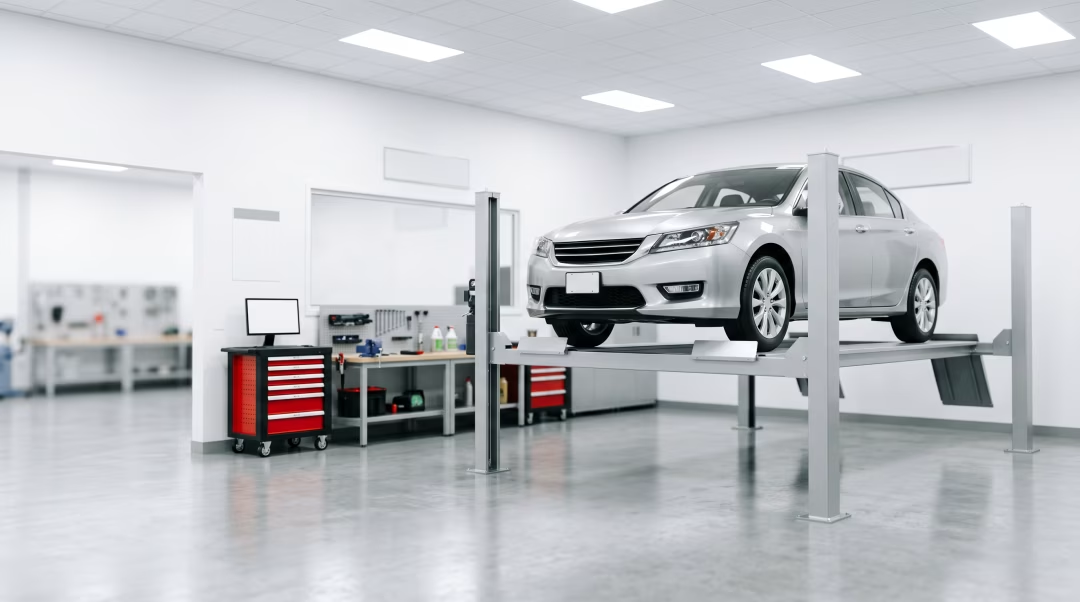
When a used car is traded in or acquired at auction, its journey to the front line of our dealership is just beginning. The process that follows, known as reconditioning, is one of the most critical aspects of our business. It is a meticulous and strategic undertaking that goes far beyond a simple wash and vacuum. Reconditioning is the comprehensive process of inspecting, repairing, and detailing a pre-owned vehicle to prepare it for sale. The core challenge is a financial and mechanical balancing act: how much should be invested in a vehicle to maximize its appeal and reliability without erasing the potential for a fair market price? This balance is what defines a quality used car and a trustworthy dealership.
Every decision made during this phase directly impacts the final product you see on our lot. An under-reconditioned car might have hidden mechanical issues or cosmetic flaws that detract from its value and your ownership experience. Conversely, an over-reconditioned car might be priced too high for the market, making it a poor value proposition despite its pristine condition. Our team of experts, which you can learn more about on our meet our staff page, leverages years of experience and market data to make informed decisions. We analyze each vehicle individually, considering its age, mileage, make, model, and existing condition to create a customized reconditioning plan.
Prioritizing Investments: Mechanical Integrity and Safety First
The foundation of any quality used vehicle is its mechanical soundness and safety. Before any cosmetic work begins, every car undergoes a rigorous multi-point inspection. This is where we identify and address the non-negotiable items that ensure the vehicle is safe and reliable for its next owner. These are not areas where corners can be cut, as they form the core of the vehicle’s value and provide essential peace of mind. Investing in these critical systems is always the first priority.
- Brake System: We inspect pads, rotors, calipers, and fluid levels. Worn components are replaced to meet or exceed safety standards, ensuring the vehicle has optimal stopping power.
- Tires: Tires are checked for tread depth, wear patterns, and age. Any tire that does not meet our stringent safety requirements is replaced to guarantee proper handling and traction in all conditions.
- Engine and Transmission: We perform diagnostic checks and fluid services to ensure the powertrain is running smoothly. Any codes, leaks, or performance issues are addressed by our certified technicians.
- Steering and Suspension: Components like tie rods, ball joints, shocks, and struts are inspected for wear and tear to ensure the vehicle drives smoothly and handles correctly.
- Essential Electronics: We verify the proper function of all essential electronics, including headlights, taillights, turn signals, and the battery and charging system.
By addressing these core mechanical areas first, we build a foundation of trust. A car that looks great but is not mechanically sound is not a vehicle we are willing to sell. Our reputation, which we detail on our about us page, is built on the reliability of our inventory.
The Art of Curb Appeal: Cosmetic Reconditioning
While mechanical integrity is paramount, the reality is that first impressions matter. Cosmetic reconditioning is about enhancing a vehicle's appearance to create strong curb appeal and instill a sense of pride in ownership. This is where the concept of return on investment becomes even more nuanced. A few hundred dollars spent on professional detailing or paintless dent removal can add thousands to the perceived value of a vehicle.
Our cosmetic process includes a thorough interior and exterior detailing, which involves deep cleaning carpets, upholstery, and all surfaces to remove stains and odors. On the exterior, we perform paint correction to remove light scratches and swirl marks, followed by a wax or sealant to protect the finish and restore its shine. Small dents and dings are often repaired using paintless dent removal (PDR), a cost-effective technique that preserves the original factory paint. Addressing torn seats, cracked dashboards, or heavily curbed wheels are other common cosmetic repairs that can dramatically improve a car's overall presentation. The goal is to make a pre-owned vehicle feel as new as possible for its next owner.
Knowing the Point of Diminishing Returns
The most challenging part of balancing reconditioning costs is knowing when to stop. There is a clear point of diminishing returns where the cost of a repair exceeds the value it adds to the vehicle. For example, performing a complete engine rebuild on a 15-year-old economy car with 200,000 miles is rarely a sound financial decision. The cost of the repair would far outweigh the car's maximum potential market value. In such cases, the vehicle may be better suited for wholesale auction rather than retail sale.
Similarly, a decision might be made to replace two tires instead of all four if the other two have significant tread life remaining. We might touch up minor paint chips but decide against a full respray of a body panel if the cost is prohibitive relative to the car’s value. These are calculated decisions based on extensive data and experience. We use market guides, auction data, and our own sales history to understand what buyers in our market value most. This data-driven approach prevents us from passing on excessive and unnecessary repair costs to our customers. If you are curious about what your current vehicle is worth and what factors we consider, our value my trade tool is an excellent resource.
Helpful Links
Frequently Asked Questions
What is the difference between reconditioning and detailing?
Detailing is a component of reconditioning, but not the whole process. Detailing refers specifically to the deep cleaning and cosmetic restoration of a vehicle's interior and exterior. Reconditioning is a much broader term that includes the full mechanical and safety inspection, any necessary repairs to brakes, tires, or engine components, and then the final detailing process before the car is offered for sale.
Do you fix every single scratch and dent on a used car?
Not always. Our goal is to balance cost and value. We address cosmetic issues that significantly detract from the vehicle's appearance and value, such as large dents or deep scratches. However, for minor imperfections that would require very expensive repairs (like a full repaint), we may choose to leave them and price the vehicle accordingly. This transparency ensures you are getting a fair price for the vehicle's actual condition.
How do you decide which mechanical parts to replace?
Our decisions are driven by safety and reliability standards. We have a comprehensive multi-point inspection checklist. Any component that fails to meet our safety criteria or shows signs of imminent failure is replaced. This includes parts like brake pads below a certain thickness, tires with insufficient tread depth, or belts and hoses that are cracked and brittle. We prioritize long-term reliability for our customers.
Does a higher reconditioning cost always mean a higher price for me?
Not necessarily. A higher reconditioning cost on our end often signifies that we have invested significantly in making the vehicle safe and reliable. While the price reflects that investment, it also means you are less likely to face unexpected repair bills shortly after your purchase. We focus on smart spending, so you are paying for value-added repairs, not just a higher price tag.
Can I see a report of the reconditioning work done on a specific vehicle?
Absolutely. We believe in full transparency and are proud of the work we put into our vehicles. We are happy to walk you through the inspection report and share the details of the specific mechanical and cosmetic work performed on any vehicle you are interested in. Just ask one of our sales professionals for the information.
