

Reduce Your Car Repossession Risk
Owning a vehicle represents a significant investment and a crucial key to your daily freedom. The ability to get to work, run errands, and manage your life depends on having reliable transportation. However, an unexpected and expensive mechanical failure can quickly derail your budget, making it difficult to keep up with monthly payments. This is where proactive care becomes your most powerful tool. Understanding how preventive maintenance reduces repossession risk is the first step toward protecting your investment and your financial stability. By staying ahead of potential issues with a simple, consistent maintenance schedule, you transform costly, surprise breakdowns into manageable, predictable service visits. This approach not only keeps your car running smoothly but also ensures you can continue making your payments on time, securing your ownership and providing invaluable peace of mind for the road ahead.
Committing to a regular maintenance routine is one of the most effective strategies for safeguarding your vehicle and your loan. It is far more affordable to invest a small amount in routine upkeep than to face a massive repair bill that could jeopardize your ability to meet your financial obligations. A well-maintained car is a dependable asset that supports your livelihood. Below, we explore the specific ways that preventive care protects you from the financial distress that can lead to repossession, offering a detailed guide to keeping your car and your budget in excellent health.
The Domino Effect: How Small Issues Become Major Headaches
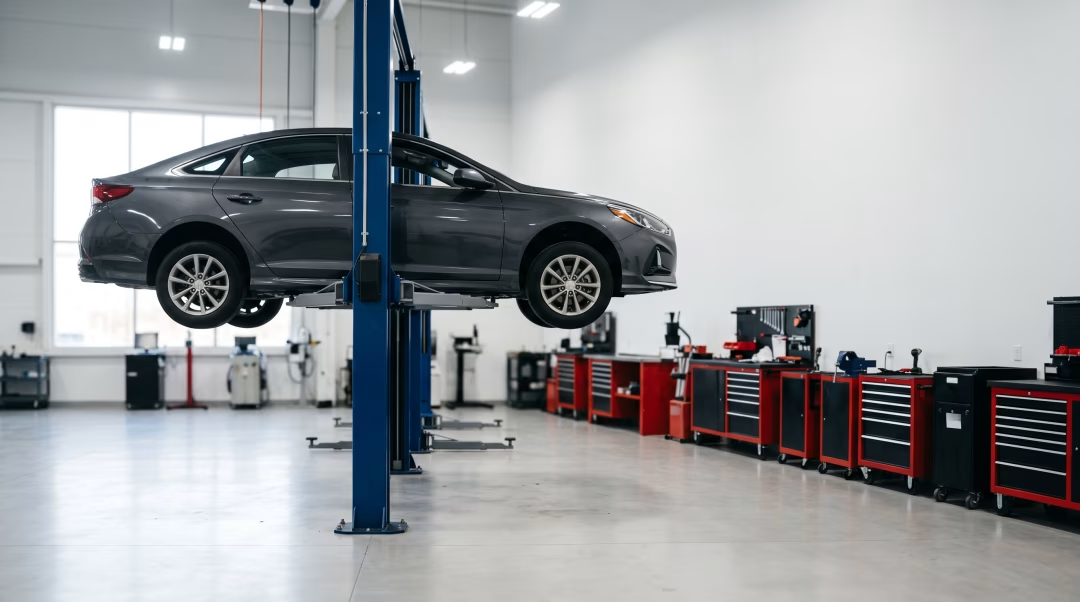
It is a common misconception that you only need to take your car to a mechanic when something feels wrong. In reality, by the time you notice a problem like a strange noise or a warning light, the underlying issue may have already caused significant and costly damage. Vehicles are complex systems where one component's failure can trigger a chain reaction. For instance, ignoring a simple, inexpensive coolant leak can lead to your engine overheating. An overheated engine can warp cylinder heads or cause catastrophic failure, resulting in a repair bill that could be thousands of dollars. Similarly, putting off a brake pad replacement, a relatively minor expense, can lead to damaged rotors and calipers, multiplying the cost of the repair.
This domino effect is precisely what preventive maintenance is designed to stop. Regular inspections and service allow a technician to spot and address these small issues before they escalate. A routine oil change is more than just new oil; it is an opportunity for a professional to look under the hood, check fluid levels, inspect belts and hoses, and identify potential leaks. This proactive approach keeps your vehicle safe and reliable while protecting you from the financial shock of a sudden, large-scale mechanical failure.
The Critical Link Between Car Failure and Loan Default
When you finance a vehicle, your monthly payment is an agreement to pay for an asset that provides value, primarily in the form of transportation. But what happens when that asset breaks down and you are faced with a repair estimate that rivals several months of car payments? This is a difficult situation for anyone, and it is a primary driver of loan delinquency and, ultimately, repossession. If a vehicle is inoperable and the owner cannot afford to fix it, the motivation to continue paying for a car they cannot use diminishes rapidly. The vehicle becomes a financial burden rather than a useful tool.
This is the critical junction where preventive maintenance proves its worth. By keeping your vehicle in good working order, you ensure it continues to provide the value you are paying for. A reliable car gets you to your job, which is how you earn the income to make your payments. It allows you to manage your daily responsibilities without the added stress and cost of alternative transportation. In short, a well-maintained car supports the very financial stability required to honor your loan agreement. Avoiding major repairs means you will not have to choose between fixing your car and making your monthly payment, a choice that unfortunately pushes many people toward repossession.
Your Proactive Guide to an Essential Preventive Maintenance Checklist
Creating a maintenance plan does not have to be complicated. The best place to start is your vehicle's owner's manual, which provides a detailed schedule of recommended services based on mileage. Budgeting around $50 to $100 per month for maintenance can also help create a fund for these routine needs, so they never come as a surprise. Partnering with a service center you trust is also key. For more great automotive tips, be sure to check out our blog.
Here are some of the most critical preventive maintenance tasks that should be on every car owner's checklist:
- Regular Oil and Filter Changes: Engine oil is the lifeblood of your vehicle. It lubricates moving parts, reduces friction, and helps keep the engine cool. Following the recommended oil change interval is the single most important thing you can do to prolong engine life.
- Tire Care and Rotation: Properly inflated tires are crucial for safety, fuel efficiency, and handling. Regularly rotating them ensures they wear evenly, extending their lifespan and saving you money.
- Brake System Inspection: Your brakes are your most important safety feature. Having a technician inspect the pads, rotors, and brake fluid regularly can prevent more expensive damage and ensure your car can stop when you need it to.
- Fluid Level Checks: Your car relies on several fluids, including coolant, transmission fluid, power steering fluid, and windshield washer fluid. Checking these levels and topping them off as needed is a simple task that prevents major system failures.
- Battery Maintenance: A dead battery can leave you stranded. Routinely checking the battery terminals for corrosion and ensuring the connections are tight can help you avoid unexpected starting issues.
- Filter Replacements: Your engine air filter, cabin air filter, and fuel filter all keep contaminants out of critical systems. Replacing them on schedule improves performance, fuel economy, and air quality inside the vehicle.
Staying on top of this checklist will keep your car dependable and significantly lower your risk of facing a budget-breaking repair. If you are looking for a reliable vehicle, explore our extensive used inventory today.
Frequently Asked Questions About Preventive Maintenance
What is the single most important preventive maintenance task?
While all maintenance is important, the single most critical task is changing your engine oil and filter at the manufacturer's recommended intervals. Clean oil is essential for lubricating engine components, preventing overheating, and avoiding premature wear. Neglecting oil changes is one of the fastest ways to cause catastrophic engine damage, leading to the most expensive type of repair.
How much should I budget for car maintenance each month?
A good rule of thumb is to set aside between $50 and $100 per month specifically for vehicle maintenance. This creates a dedicated fund for routine services like oil changes and tire rotations, as well as for replacing wear-and-tear items like brakes or tires when they are due. The exact amount will vary based on your vehicle's age, make, and model, but budgeting consistently prevents these costs from becoming a financial surprise.
Can I do some of these maintenance tasks myself to save money?
Absolutely. Many simple tasks can be performed at home with minimal tools, helping you save on labor costs. These include checking and topping off fluids like windshield washer fluid and coolant, visually inspecting belts and hoses for cracks, checking your tire pressure with a gauge, and replacing your engine and cabin air filters. However, more complex jobs like brake work or oil changes are often best left to a professional unless you have the proper experience and equipment.
My car already has high mileage. Is preventive maintenance still worth it?
Yes, it is more important than ever for high-mileage vehicles. As a car ages, its components are more susceptible to wear and tear. A consistent maintenance schedule can significantly extend the life of an older car and prevent the common failures associated with high mileage. Sticking to the service plan helps protect your engine, transmission, and other critical systems, making your investment last as long as possible.
What happens if I ignore a Check Engine light?
Ignoring a Check Engine light is a major risk. While it can sometimes indicate a minor issue like a loose gas cap, it can also signal a serious problem with your engine, transmission, or emissions system. Continuing to drive without having the code diagnosed can turn a small, fixable problem into severe and expensive damage. It is always best to have the vehicle checked by a qualified technician as soon as possible.
