

Buy Here Pay Here (BHPH) Industry
The Buy Here Pay Here (BHPH) industry provides a vital service for car buyers with challenging credit, but it is not a one-size-fits-all business. The way a BHPH dealership operates is profoundly shaped by its location. From state-level financing laws and consumer protection regulations to local economic conditions and even the climate, regional differences create unique opportunities and challenges. A successful dealership in the snowy Northeast will stock different inventory and structure deals differently than one in the Sun Belt. Understanding these geographic nuances is key to appreciating how the BHPH market adapts to serve diverse communities across the country. These factors influence everything from vehicle pricing and inventory selection to underwriting standards and collections strategies. Recognizing this local variability helps customers understand why their experience at one dealership may differ significantly from another, even within the same state. It is a landscape defined by local needs and governed by local rules.
Navigating the world of in-house financing means understanding that your local environment plays a huge role. The vehicles we offer in our used inventory and the financing terms available are tailored to the realities of our community. We consider local employment trends, transportation needs, and state-specific regulations to create a business model that is both sustainable and fair to our customers. This localized approach ensures we can provide reliable transportation solutions that make sense for your budget and lifestyle, right here where you live and work.
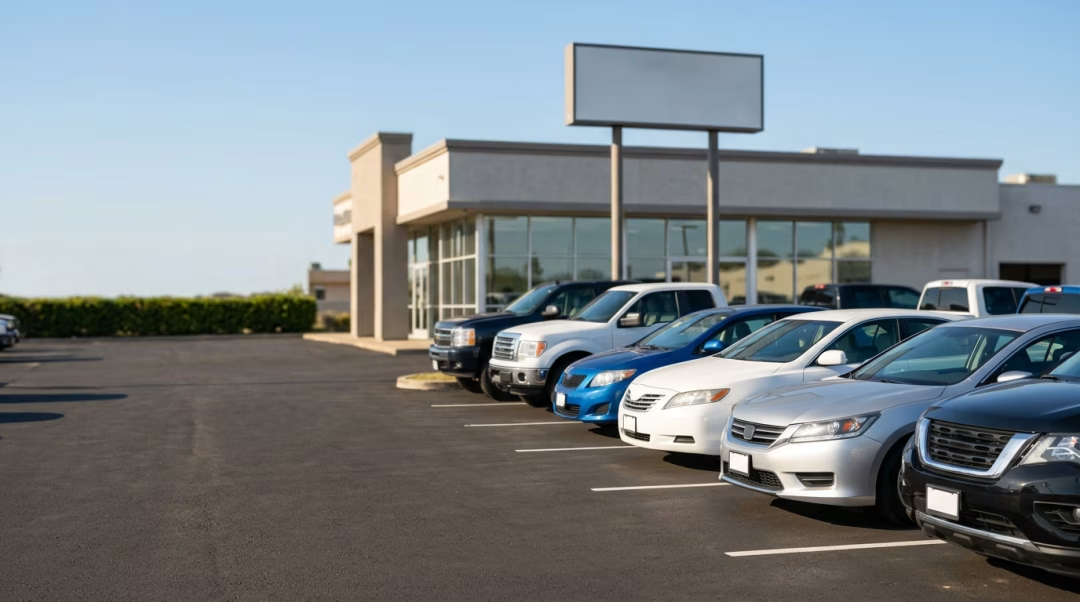
The Geographic Mosaic of BHPH Dealerships
When people think of a Buy Here Pay Here car lot, they often picture a single, unchanging business model. The reality is far more complex and interesting. The BHPH industry is a mosaic, with each piece shaped by the unique characteristics of its region. A dealership's success hinges on its ability to adapt its inventory, financing, and operational strategies to the specific legal, economic, and even environmental conditions of its location. These external forces dictate not only how a dealer serves its customers but also the very structure of its business. For potential buyers, understanding these differences can demystify the process and explain why terms, vehicle selection, and policies can vary so much from one city or state to another.
State and Local Regulations: The Defining Factor
Perhaps the single most significant regional influence on the BHPH industry is the legal and regulatory landscape, which varies dramatically from state to state. These laws create the framework within which a dealer must operate, affecting nearly every aspect of the business. Navigating this complex web is essential for compliance and long-term success. For more details on our own policies, you can review our terms of use.
- Interest Rate Caps (Usury Laws): Some states impose strict limits on the maximum interest rate that can be charged on a loan, while others have more lenient or no caps for certain types of financing. In a state with a low cap, a BHPH dealer must adjust their business model, often by focusing on higher down payments or shorter loan terms to mitigate risk. In contrast, states with higher caps allow for more flexibility in pricing risk into the interest rate.
- Repossession and Recovery Laws: The process for repossessing a vehicle after a loan default is strictly governed by state law. Some states have "right to cure" laws that give customers a specific period to catch up on payments before repossession can occur. The rules for understanding repossession laws by state, including how post-repossession notices are handled and how any surplus from the vehicle's sale is managed, create different risk profiles for dealers.
- Licensing and Bonding: The requirements to become a licensed auto dealer and finance provider differ everywhere. Some states have minimal requirements, while others demand extensive background checks, significant surety bonds, and ongoing education. These barriers to entry can affect the number of operators in a market and the level of professionalism.
- Documentation and Disclosure Rules: State laws, alongside federal regulations like the Truth in Lending Act, dictate exactly what must be included in a retail installment contract. Variations in required disclosures about financing terms, fees, and consumer rights mean that legal documents used in one state may be non-compliant in another.
Economic Drivers and Local Demographics
The economic health and demographic makeup of a region are fundamental forces that shape the local BHPH market. A dealership's entire approach to underwriting and inventory must be aligned with the financial realities of its customer base. A dealer in a region dominated by a single industry, like manufacturing or agriculture, will face different challenges than one in a diverse urban economy. For example, seasonal employment in agriculture or construction can lead to fluctuating payment consistency, prompting dealers to offer more flexible payment schedules. In contrast, an area with stable, year-round employment might support more traditional weekly or bi-weekly payment plans.
Population density also plays a critical role. In sprawling rural areas with limited public transportation, a personal vehicle is not a luxury but a necessity for getting to work, school, and essential services. This creates a consistent, high-stakes demand. In these regions, customers may prioritize durability and utility, leading to higher demand for trucks and SUVs. Conversely, in dense urban centers, customers might prefer smaller, more fuel-efficient vehicles for navigating traffic and tight parking. Our team, which you can learn about on our meet our staff page, is trained to understand these local nuances.
Climate and Geography's Impact on Inventory
The local weather and terrain have a surprisingly direct impact on a BHPH dealer's inventory strategy. A vehicle that is perfect for a driver in Florida could be a poor choice for someone in Colorado. Smart dealers source and stock vehicles that are well-suited to the local environment to ensure customer satisfaction and reduce the likelihood of mechanical issues that can lead to defaults.
In the "Salt Belt" of the Midwest and Northeast, where roads are heavily treated with salt in the winter, rust and corrosion are major concerns. Dealers in these areas must carefully inspect vehicles for undercarriage decay and often prioritize models known for their durability against corrosion. Customers are also more likely to demand vehicles with all-wheel drive (AWD) or four-wheel drive (4WD) to handle snow and ice.
In the hot, sunny climates of the South and Southwest, a functioning air conditioning system is non-negotiable. A dealer who sells a car with a weak A/C will face immediate customer dissatisfaction. Furthermore, intense sun can damage paint, dashboards, and upholstery, so vehicles that have been well-maintained or garaged are more desirable. In mountainous regions, vehicles with stronger engines and robust braking systems are more practical, while coastal areas with high humidity present their own set of challenges for vehicle electronics and interiors.
The Competitive Landscape
Finally, the nature of local competition shapes a BHPH dealer's strategy. In some markets, a single BHPH dealership may serve a wide area with few competitors. In this scenario, the dealer may have more pricing power and a larger pool of potential customers. However, in other regions, particularly large metropolitan areas, the market can be saturated with dozens of BHPH lots, independent used car dealers, and franchise stores with subprime financing departments.
This intense competition forces dealers to differentiate themselves. Some may compete on price, offering lower down payments or more competitive interest rates. Others might focus on vehicle quality, offering more rigorous inspections or limited warranties. Still others build their brand around customer service, flexible payment options, or a commitment to helping customers rebuild their credit. The marketing strategies also change; a dealer in a competitive market must invest more heavily in local SEO, online advertising, and community engagement to stand out. To learn more about our company's philosophy, please visit our about us page.
Why does vehicle selection differ so much between BHPH dealers in different states?
Vehicle selection is heavily influenced by regional climate and customer needs. Dealers in northern states prioritize all-wheel-drive vehicles and those resistant to rust, while southern dealers focus on cars with strong air conditioning. In rural areas, trucks and larger SUVs are more popular, whereas compact cars are favored in dense cities.
Are interest rates for BHPH loans the same everywhere?
No, they are not. Each state sets its own laws regarding maximum allowable interest rates, known as usury laws. Some states have strict caps, forcing dealers to adjust other factors like down payments, while other states have higher or no limits, allowing for more risk to be priced into the rate.
How do local economies affect my ability to get a BHPH loan?
Dealers in areas with stable, year-round employment may have more rigid underwriting standards. In regions with seasonal work, such as agriculture or tourism, dealers are often more accustomed to fluctuating incomes and may offer more flexible payment plans to accommodate the local economy's rhythm.
Can a dealer repossess my car the day after a missed payment?
This depends entirely on state law. Some states have "right to cure" provisions that give you a grace period to make a payment before repossession can legally occur. Other states allow for immediate action once the contract is breached. It is crucial to understand the specific repossession laws in your state.
Why are down payments higher in some regions than others?
Down payment requirements are a function of risk management for the dealer. In states with low interest rate caps, dealers cannot charge as much to cover potential losses, so they often require a larger down payment. High local competition can also drive down payments lower as dealers compete for customers.
