
Days to Frontline Ready Time
In the competitive used car market, speed is profit. Every day a vehicle sits on your lot waiting for reconditioning, detailing, and photography is a day it is costing you money and missing a potential buyer. This crucial period, known as "days to frontline ready," directly impacts your dealership's cash flow, inventory turn, and overall profitability. Reducing this timeline from weeks to mere days is not just an operational goal; it is a fundamental business strategy. A streamlined process ensures you can acquire desirable inventory, prepare it for sale with maximum efficiency, and list it online faster than your competitors. By optimizing every step from acquisition to the moment a car is ready for a test drive, you unlock significant potential for revenue growth and reduce costly holding expenses. Mastering your frontline ready process is the key to a healthier, more profitable dealership that can adapt quickly to market changes and customer demand.
Achieving a rapid frontline ready time requires a holistic approach that examines your people, processes, and technology. It involves creating standardized procedures, fostering clear communication between departments, and leveraging the right tools to eliminate bottlenecks. From the moment a vehicle arrives until its photos are shining on your website, every action must be intentional and efficient. By implementing the strategies detailed below, you can transform your reconditioning cycle from a cost center into a powerful competitive advantage that drives faster sales and higher profits.
A Strategic Blueprint for Accelerating Inventory Turn
The concept of "days to frontline ready" (DFR) measures the total time elapsed from when a dealership officially acquires a vehicle to when it is fully reconditioned, detailed, photographed, and displayed for sale online and on the physical lot. This metric is one of the most critical key performance indicators (KPIs) for any used car operation. High DFR times lead to increased holding costs, which include floor plan interest, insurance, and depreciation. More importantly, a slow process means you are missing out on sales opportunities in a fast-moving market. A vehicle that is stuck in recon for ten days could have been sold on day three. The goal is to create a seamless, predictable, and rapid workflow that minimizes this non-revenue-generating period. This requires a detailed examination of every touchpoint in the vehicle's journey through your dealership.
Phase 1: Streamlining Intake and Initial Assessment
The clock on DFR starts the second you own the vehicle, not when it arrives on your lot. The first phase is critical for setting the pace for the entire process. Any delays here will cascade and cause significant bottlenecks later. The intake process must be as methodical as a pit crew's routine.
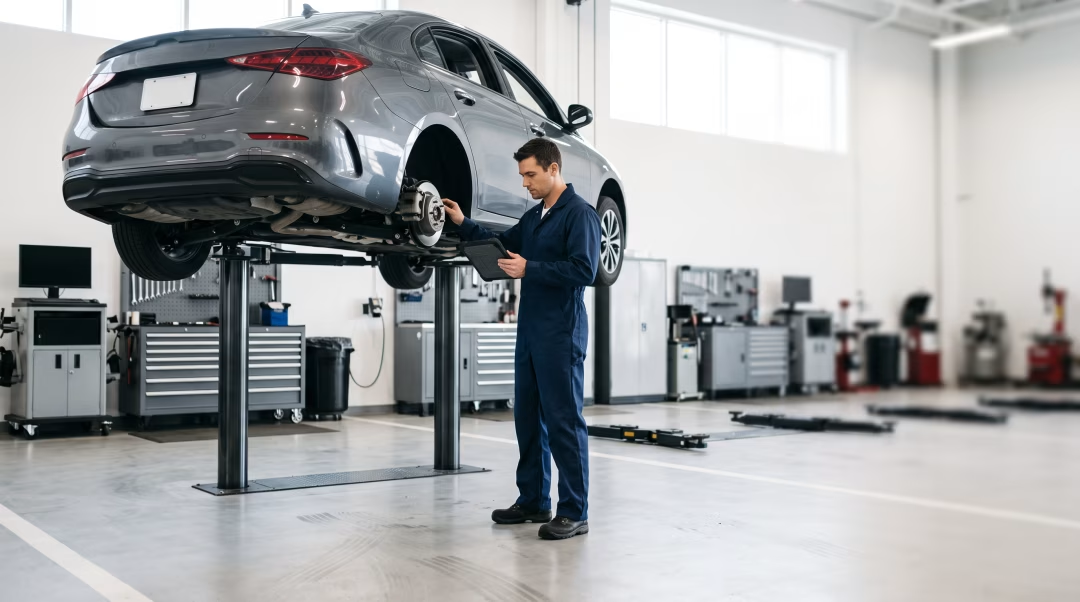
Upon arrival, every vehicle should immediately undergo a standardized check-in procedure. This includes verifying the VIN, noting any transport damage, and logging its arrival in your Dealer Management System (DMS). The next step is an initial triage inspection. This is not a full mechanical diagnosis but a quick assessment to identify the scope of work required. A dedicated team member should use a digital checklist to evaluate mechanical needs, cosmetic repairs, and detailing requirements. This initial assessment allows you to categorize the vehicle and route it to the appropriate department immediately. Vehicles needing only a standard detail and inspection should be fast-tracked, while those requiring significant mechanical or body work are sent to the proper service bay or vendor without delay.
Phase 2: Optimizing the Reconditioning Workflow
The reconditioning stage is where most dealerships experience the biggest delays. A lack of clear communication, poor parts management, and inefficient workflows can add days or even weeks to the process. To combat this, you must treat your recon department like an assembly line, where each step is optimized for efficiency and quality.
- Parallel Processing: Avoid a linear workflow where one task must be completed before another begins. Whenever possible, perform tasks simultaneously. For example, while a minor mechanical repair is being done, parts for another job can be ordered, and the interior detail can be started.
- Standardized Repair Tiers: Create pre-approved reconditioning packages or tiers. For example, a "Tier 1" vehicle might receive a fluid top-off, new wiper blades, and a full detail, with a pre-set budget and approval. This eliminates the need for managers to approve every minor repair, which is one of the most common operational bottlenecks.
- Vendor Management: Build strong relationships with reliable external vendors for services like paintless dent repair, wheel refinishing, and glass replacement. Schedule them to be on-site on specific days of the week to work on multiple cars at once, rather than sending vehicles off-site, which adds significant transport time.
- Parts Procurement: The "waiting for parts" excuse is a major profit killer. Empower your technicians or a dedicated parts manager to order necessary components as soon as a vehicle is diagnosed. Establish accounts with multiple suppliers to ensure you can get parts quickly and avoid single-source delays.
Phase 3: Perfecting Final Merchandising and Quality Control
A vehicle is not frontline ready until it is effectively merchandised online. The final steps of photography, description writing, and pricing are just as crucial as the physical repairs. This stage should have its own dedicated workflow to prevent delays after the hard work of reconditioning is complete.
Designate a specific, well-lit area or a dedicated photo booth for vehicle photography. This ensures consistent, high-quality images regardless of weather or time of day. The photographer should follow a strict shot list, capturing all the angles and features that customers want to see. As soon as the photos are taken, they should be uploaded to a shared server where a team member can immediately write compelling vehicle descriptions and set the price. The goal is to have a vehicle listed online within hours of its final detail. A final quality control check should be performed to ensure the vehicle is mechanically sound, cosmetically appealing, and accurately represented on your website. Learn more about how a professional online presence can help by exploring our BHPH dealer website SEO services.
Measuring Success and Driving Continuous Improvement
You cannot improve what you do not measure. Implementing a system to track DFR is non-negotiable. Use your DMS or a dedicated reconditioning software to monitor each vehicle's progress through every stage. Create dashboards that provide real-time visibility into where each car is in the process and how long it has been there. Hold weekly meetings with department heads from sales, service, and detail to review your DFR metrics. Identify the bottlenecks from the previous week and collaborate on solutions. By fostering a culture of accountability and continuous improvement, you can steadily chip away at your average frontline ready time, leading to faster inventory turn, reduced costs, and a significant boost to your bottom line.
What exactly is "days to frontline ready" or DFR?
Days to frontline ready, often abbreviated as DFR, is a key performance indicator for used car dealerships that measures the total number of days it takes from the moment a vehicle is acquired to the moment it is fully reconditioned, inspected, detailed, photographed, and made available for sale to customers on the lot and online.
What is a good industry benchmark for frontline ready time?
While this can vary based on dealership size and resources, top-performing dealerships consistently aim for an average DFR of 3 to 5 days. Many dealerships operate in the 7 to 10-day range, which represents a significant opportunity for improvement. Anything consistently over 10 days indicates serious inefficiencies that are costing the dealership money in holding costs and missed sales.
How can technology help reduce our DFR?
Technology is a powerful accelerator. A modern Dealer Management System (DMS) or dedicated recon software can provide real-time tracking of each vehicle's status, digital checklists for inspections, and automated notifications to move cars to the next stage. This eliminates manual communication gaps and provides managers with the data needed to identify and resolve bottlenecks quickly.
Where do most dealerships lose the most time in the reconditioning process?
The most common bottlenecks occur in three main areas: waiting for repair approvals, waiting for parts to arrive, and poor communication between the mechanical, cosmetic, and detail departments. Creating pre-approved repair limits and improving parts management processes can solve the first two, while a centralized technology platform can solve the communication problem.
What is the first step our dealership should take to improve its DFR?
The first step is to accurately measure your current process. You need to map out every single step a vehicle takes from acquisition to frontline ready and time how long it spends in each stage. This baseline data will immediately reveal your biggest bottlenecks and show you where to focus your initial improvement efforts for the greatest impact.
